Bhutan: Nabji Trail Adventure Day 1
Book now!
Arrive at Paro; drive to Thimphu
The flight into Paro (2200m/ 7800ft) on the national carrier, Druk Air, is a befitting introduction to the spectacular beauty of Bhutan. From a window seat on clear days you can enjoy a spectacular view of Bhutan’s snow capped peaks as you approach Paro. On arrival you will be received by your guide and your driver who will drive you to the capital city, Thimphu (2400 m / 8000 ft). The hour-long drive follows the rivers of Paro and Thimphu. You will have ample time to look around the city, the only capital in the world with no traffic lights.
Dinner and overnight at hotel.
Thimphu siteseeing
After breakfast visit the Memorial Chorten built in the memory of the third King, Jigme Dorji Wangchuck. Drive to Motithang for a bird’s eye view of the capital city. Visit the mini zoo to get upclose with ‘Takin,’ the national animal of Bhutan. Takins are a unique looking animal and are the only occupants of the mini zoo. There is an interesting story to their existence, which you will hear from your guide. Drive to Drubthop Lhakhang, the nunnery temple. Return to town for lunch at a local restaurant. After lunch visit the Bhutanese Indigenous Hospital, Traditional Painting School, National Library and continue your drive south to Lungtenzampa, visit the Royal silversmith at work and then stop by at the Bhutanese Paper factory. Time permitting we will visit Simtokha Dzong (fortress), the first Dzong in Bhutan built in 1624; it currently houses the Institute of Learning for Culture and Buddhist Studies.

Dinner and overnight at hotel.
Excursion to Punakha Valley
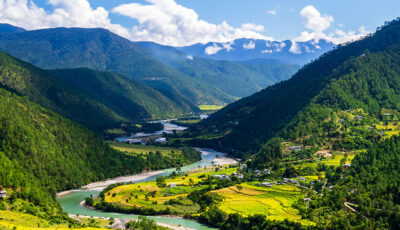
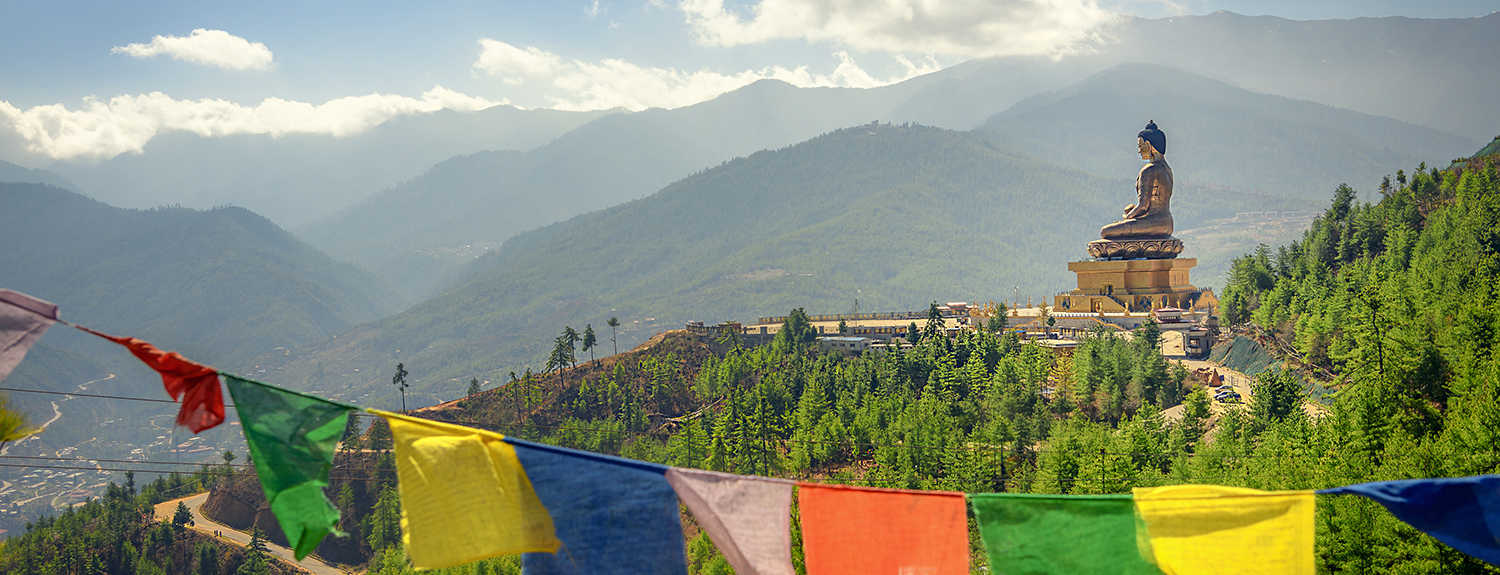
Leaving Thimphu the road gradually climbs through a forest of pine and cedar, festooned with hanging lichen high up near Dochula pass (3,050 m/10,000ft). This pass offers panoramic views of the Himalayan mountain ranges. After a brief stop to catch the breathtaking views, we will descend along a series of hairpin bends to the fertile valley of Punakha (1,350 meters/ 4,430 feet). Before proceeding further to Punakha town we will hike through rice fields to Chimi Lhakhang temple located on a small hilltop. This temple is dedicated to the great Yogi in 14th century known as Drukpa Kuenley or popularly known as the “Divine madman” in the west. It is believed that this temple blesses women who seek fertility. A popular pilgrimage spot for the Bhutanese, it is frequented by childless couples and parents who have difficulty raising children. After Lunch, continue your drive towards Punakha Dzong (Fortress) situated between the two rivers Pho Chu and Mochu (Male and Female River). This fortress is now used as the winter seat of the Je Khenpo (the Spiritual head of Bhutan). This Dzong had served as the capital seat of the Kingdom for more than three hundred years.

Dinner and overnight at hotel.
|
||||||||||||||||||||||||||||||||
![]() |
![]() |
![]() |
![]() |
|||||||||||||||||||||||||||||
Bhutan: Nabji Trail Adventure Day 4 Punakha - Trongsa Valley The drive to Trongsa takes approximately 6 hours. We start early for the fabulous drive to the central valleys of Bhutan through Bhutan’s rich flora and fauna. As we cross the fertile valley of Punakha and enter into the valley of Wangdue Phodrang. We take an opportunity to photograph the majestic fortress of Wangdue Dzong, which stands on a spur of a hill at the confluence of the Tsang Chu and Dang Chu rivers. We then climb steadily passing through subtropical vegetation and then to Pele la Pass (3,300 m/ 10,989 ft.). With an alpine environment of rhododendrons and dwarf bamboo, the Pass is traditionally considered the boundary between West and East Bhutan. In clear weather we can view the high snow capped peaks including Mount Chomolhari (7,314 m/ 24,355 ft.).
As we descend from the pass through the dwarf bamboo we reach Chendebji Chorten. This Chorten (Stupa) was built in 18th century by a Lama known as Shida, in order to subdue a demon that had been terrorizing the inhabitants of this valley and the Ada valley just over the ridge. We will have our lunch here. We may encounter herds of yaks on the way. Continue your drive to Trongsa; the huge fortress of Trongsa dominates the entire landscape. Like all other Dzongs, it is strategically located, perched atop a hill. You will get a watchman's expansive view from the watch tower, which is now being converted to a museum. Arrive Trongsa. Dinner and overnight at hotel. Day 5 Tongtongphey (1,000m) - Jangbi ( 1,350m); 3 hours Today is the first day of the trek. After furnishing yourself with ample information about the trek from the information booth at the Park Range office in Tongtongphey, the Jangbi village guide steers you down to the Mangdi river where you cross a suspension bridge. The first day brings you in contact with the Monpas who are believed to be the first inhabitants of Bhutan. A glimpse of their lifestyle verifies this claim. The campsite in Jangbi stands on the valley sill, which offers a magnificent view of the Mangdi valley.
Overnight camp. Day 6 Jangbi (1,350m) - Kudra (1,500m); 6 hours The morning allows you to further interact with the Monpas. Before you proceed, you could pay a visit to the orchid garden to satiate your thirst for botanical photography. The hike to Kudra provides a jovial atmosphere because this part of the trail meanders along stone imprints of Guru Rinpoche’s footprints, dagger and phallus, festooned by stories that espouse Guru’s praxis. Lunch is served just before you reach Ugyendra, a steep cliff below Phrumzur, one of the few villages of the Monpa communities scattered around the trail. With renewed energy from lunch, you could visit the village lhakhang and then proceed to the campsite in Kudra.
Overnight Camp Day 7 Jangbi (1,350m) - Kudra (1,500m); 6 hours Wake to the distant call of the Rufous-necked hornbill. This part of the trek is a collage of streams, waterfalls and thick forests that will give you an invigorating feeling of being out in the wild. The Great Himalayan Squirrel, Rhesus Mecaques, and small snakes are often spotted along the trail. Unseen but present, are Himalayan black bear, Red pandas, tigers, Clouded leopards and many more. Upon arrival at the holy tree in Nabji, you will receive a heartwarming reception from villagers. Nabji is a beautiful village with endless paddy fields demarcating the valley and surrounding the campsite. Overnight Camp Day 8 Nabji village (1,300m) - Korphu (1,500m); 3 hours En route to Korphu, the Nabji temple is located in the middle of the paddy fields. Inside, there remains a stone pillar on which Guru Rinpoche, while traveling through Bhutan in the 8th century, brought consensus between two warring kings: King sindha Gyalp of Bumthang, and King Noeche, by imprinting their thumbs on each side of the stone. Korphu is situated on a mountaintop at an altitude of 1,500m. The most striking thing about Korphu is the people’s hospitality: almost treating you like ‘A King on accession to throne.’ You have the option of being welcomed with a traditional ‘Chipdrel’ procession and a ‘Marchang’ ceremony, singing traditional songs of praise and wellbeing for new visitors. They also perform the traditional ‘Tashi Labey’ dance to bid you farewell. If you are interested, you can participate in the quintessential Bhutanese games of ‘Khuru,’ ‘Dego,’ ‘Sok-sum,’ and ‘Gee-dum,’ all on the brink of disappearance. You could also pay a visit to the village temple that houses the sacred relics of Pema Lingpa, the famous ‘Treasure revealer’ of Bhutan. The village campsite provides a spectacular bird’s-eye view of Nabji and surrounding areas. Overnight Camp Day 9 Korphu (1,500m) - Nyimshong (1,300m), 5 hours The hike from Korphu to Nyimshong is arguably the best birding route-- boasting a bird list of more than 395 species, featuring the elusive Rufous Necked Hornbill with its nesting holes adjacent to the trail, among others. The walk is mixed with waterfalls and, streams and cantilever bridges. The evening brings you to Nyimshong, a village of reticent architecture and lifestyle. The women of Nyimshong have a penchant for singing and dancing and a cultural show would be ideal to celebrate the end of your trek. Overnight Camp
|
||||||||||||||||||||||||||||||||
Bhutan: Nabji Trail Adventure Day 10
Book now!
Nyimshong (1,300m) - Reotala (1,000m), 3 hours
If you are lucky, the Golden langurs will lead you to the trail’s end. Descend down to the Mangdi river again to see some herons and River-lapwings. An hour’s steep ascent to the road and your driver will drive you back to Trongsa.
Dinner and overnight at hotel in Trongsa.
Day 11
Drive to Phobjikha/Gangtey Valley
After breakfast, we will drive to Phobjikha Valley, also known as Gangtey Valley. Our journey will take us over Pelela pass, soon after you make a left turn following a road that heads to Phojikha valley over Tashi La Pass. Phojikha valley is an open wide valley, where Gantey Gompa is ideally located on a hill over looking the valley. It is also the winter habitat for the Black necked cranes migrating from Tibet. To protect the cranes, the government allows no electric poles and cables in the valley.

This valley also serves as the winter home for the rare black-necked cranes that migrate from the plateau of Tibet when it gets extremely cold. The birds migrate sometime in mid-October and return to Tibet in March/April. The villagers celebrate their arrival. The Black-necked Crane is also known as 'Thrung Thrung Karmo' and is deeply revered as a heavenly bird (lhab-bja), which has harmoniously coexisted with the residents largely due to strong Buddhist beliefs. The lhab-bja appears in the Bhutanese folklore, songs, dances and historical references. You will most likely have the opportunity to witness these graceful cranes feeding in the marshy meadow. We will be dropped off before arriving at the Gangtey Monastery and take a hike through a village to the monastery and then continue downhill into the Phobjikha valley. We will continue our hike to the hotel where we will be served lunch. The rest of the day will be available for us to explore the village, visit the newly completed Gangtey Monastery, or observe the cranes during the crane season.
Dinner and overnight at hotel.
Day 12
Phobkjikha - Thimphu
You will resume your journey to Thimphu after breakfast; en route we will stop briefly in Wangdiphodrang, where we will stroll around what is left of the old Wangdiphodrang town. We may visit Wangdiphodrang Dzong, built in 1638. Legend has it that when people were searching for a site to build the Dzong, four ravens were seen flying away in four directions. This was considered an auspicious sign, representing the spread of religion to the four points of the compass. The Dzong is situated at the confluence of Punatsang Chu and Dang Chu rivers. We will have our lunch either in Wangdiphodrang or Lobeysa, which is twenty-minutes drive from Wangdiphodrang. After lunch, we will continue our journey to Thimphu. We may stop at Docula pass to capture the panaromic view of the majestic Himalayas. Upon arrival in Thimphu, you will have the evening for walking around the town and for some shopping, if you like.
Dinner and overnight at hotel.
Bhutan: Nabji Trail Adventure: Logistics
Book now!
Inclusions:
Exclusions:
Visa
All visitors to Bhutan require a visa prior to arrival in the country. Visa clearance takes at least 10 days to process. Air tickets to Bhutan cannot be purchased without visa clearance. Once the visa is obtained, the government sends copies of the visa to the point of entry into Bhutan and to your travel provider. Elevate Destinations will then send a copy to you before departure. Visas are issued for a 14 day period; extensions can be obtained in Thimphu, the capital of Bhutan.
Download Visa application here
Best Times of Year
The Nabji Trail Adventure is open from March through October, the best time being March, September and October. Being a sub-tropical area, April-June can be humid and warm/hot and in July-August, there will be plenty of rainfall in that region.
Getting into Bhutan (via Air):
The best way to enter Bhutan is by Druk Air ('Druk' means Dragon), the national air carrier. The flight into Paro International Airport, Bhutan's only airport is one of the most spectacular flights in the world. Druk Air has two flight schedules - a summer and winter flight schedule. They differ in timings though the days of operation remain the same. Once the tour is finalised and payment is made, the visa is being processed and obtained by us on your behalf. You can book the flights only after obtaining the visa. Druk Air has flights from/to India (New Delhi, Kolkatta and Gaya), Thailand (Bangkok), Nepal (Kathmandu) and Bangladesh(Dhaka).Druk Air is the only airline operating in Bhutan. The airline operates two Airbus A319.For current flight schedules and fares, please check Druk Air's web site. This will help you plan your trip.
Payment
We require a deposit of 50% to confirm a booking. The balance is payable 90 days before planned departure date.
Owing to the small size of our trips, payment is non-refundable. We recommend trip insurance to cover any unexpected cancellations.